



Jamshedpur.
P N Bose started his professional journey with the Geological Service of India and retired from his government role in 1904 to take on the position of Principal Geologist in the Princely State of Mayurbhanj. His most significant accomplishment was identifying iron ore deposits in the Gorumahisani hills in Mayurbhanj.
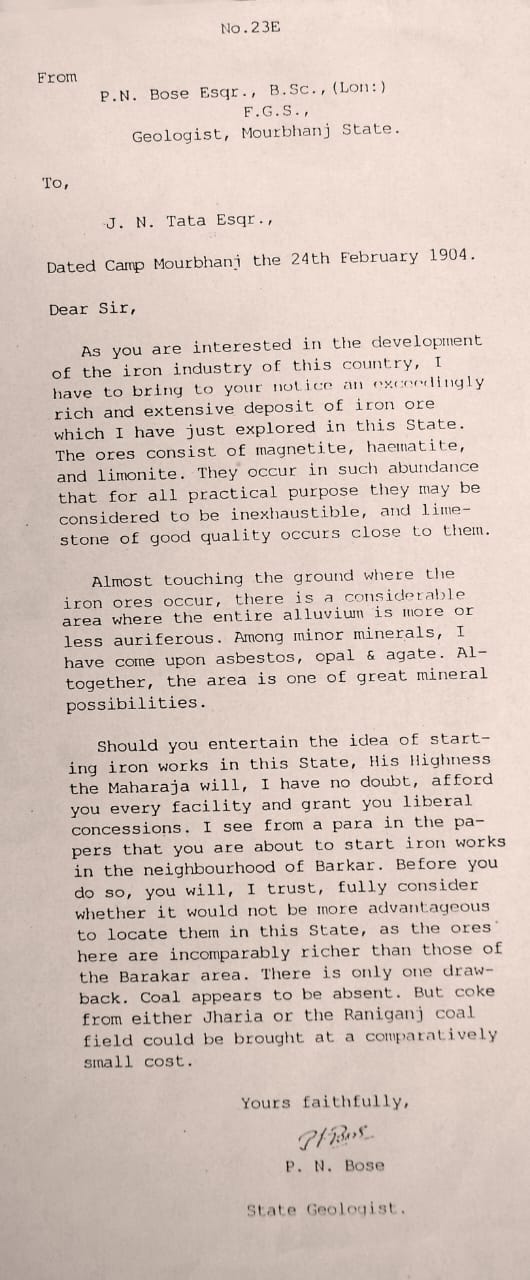
After making this discovery, P N Bose sent a letter to J N Tata on February 24, 1904, emphasising the presence of high-quality iron in Mayurbhanj and coal in Jharia, which played a crucial role in the Tatas’ plans and eventually contributed to the founding of the Tata Iron and Steel Company in Sakchi.
By 1906, the Government of India removed obstacles to establishing a steel plant, officially promising to support the Tatas by committing to purchase steel for a designated period and offering additional assistance. The company was formally registered in India on August 26, 1907, with an initial capital of Rs. 2,31,75,000. Following this, construction of the steelworks commenced in 1908, and by February 16, 1912, production had officially started.
The Tata family’s quest for raw materials to produce steel began in the Chanda district of the Central Provinces, where they discovered iron at Lohara and coal at Warora. However, both resources proved unsuitable for steel production. During a visit to the Nagpur secretariat, Dorabji Tata had an unexpected encounter that would influence their search. When he found himself waiting to meet the commissioner, he decided to visit a nearby museum. There, he was captivated by a colourful geological map showcasing the impressive iron ore deposits of Dhalli-Rajhara. Despite the high quality of the iron ore, the absence of cokable coal and water resources led to the conclusion that Dhalli-Rajhara was also not a viable option for their steel-making endeavours.
The letter from P N Bose changed the course of history and shaped the destiny of Indian steelmaking.
====================
